KIDANVerse

KIDANVerse

End-to-end security operations monitoring.
Expert guidance for strategic technology decisions.
Enterprise services supporting critical IT infrastructure.
Seamless enterprise technology solution deployment.
Empower teams with expert-led technology programs.
Gain complete visibility into your technology infrastructur
Tailored IT solutions for operational excellence.
Expert on-demand consultation for technology procurement
Dedicated IT support for seamless operations.
Anything else ? please
contact us
Reach out to KIDAN for inquiries and support.
24/7 global technology operations center.
Expert guidance for strategic technology
decisions.
Learn more about KIDAN’s vision, values, and expertise.
Proactive security operations to
protect data asset
Intelligent operations control for
agile IT systems
Ensuring smooth network operations
and uptime 24/7
Anything else ? please
contact us
Expert guidance for strategic technology
decisions.
Learn more about KIDAN’s vision, values, and expertise.











Strategic Vendor Partners
Technical Managed Solutions
Enterprise clients across industry sectors
Something quietly shifted over the last two years.
AI tools stopped being something IT evaluated and started being something everyone just used. Copilot, Gemini, and dozens of niche tools your security team has never reviewed. They are inside your organisation right now. Being used to summarise documents, draft contracts, write code, respond to clients.
Some with your knowledge. Most without.
This is what the industry calls shadow AI. And it is one of the most significant blind spots in enterprise security today. Not because AI is dangerous by nature, but because ungoverned AI use creates gaps that traditional security was never designed to cover.
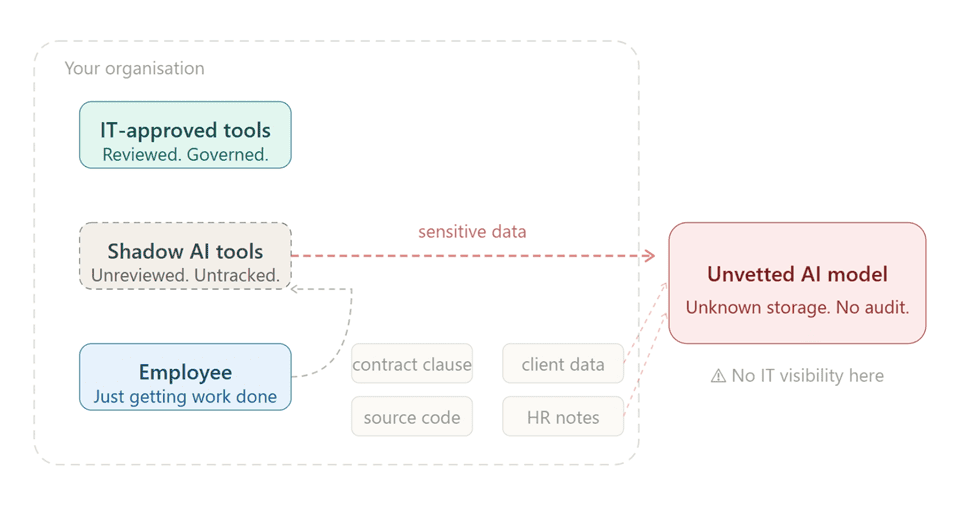
When employees use unapproved tools to do their work, sensitive data travels somewhere your security policies never anticipated.
Think about what gets typed into an AI prompt on any given workday: a contract clause under negotiation, a client’s financial data being analysed, internal source code being debugged, an HR note about a specific employee.
None of that was meant to leave your systems. But it did. Into a model trained by a company you have never vetted, processed on infrastructure you have no visibility into, stored in ways you cannot audit.
Three out of four CISOs have already discovered unsanctioned AI tools running in their environments. Another 16 percent are not sure, which likely means they have the same problem. What makes this particularly difficult to manage is that these tools are not confined to browser-based assistants. They often come with embedded credentials, API integrations, or OAuth tokens that plug directly into enterprise systems, operating with elevated permissions and completely outside standard provisioning workflows.
Shadow AI breaches cost an average of 670,000 dollars more than traditional incidents and take longer to detect, averaging 247 days. The detection approach that works: use a Cloud Access Security Broker (CASB) and network analysis tools to spot traffic going to unapproved AI services, pair this with a clear AI Acceptable Use Policy, and give employees a sanctioned, secure alternative.
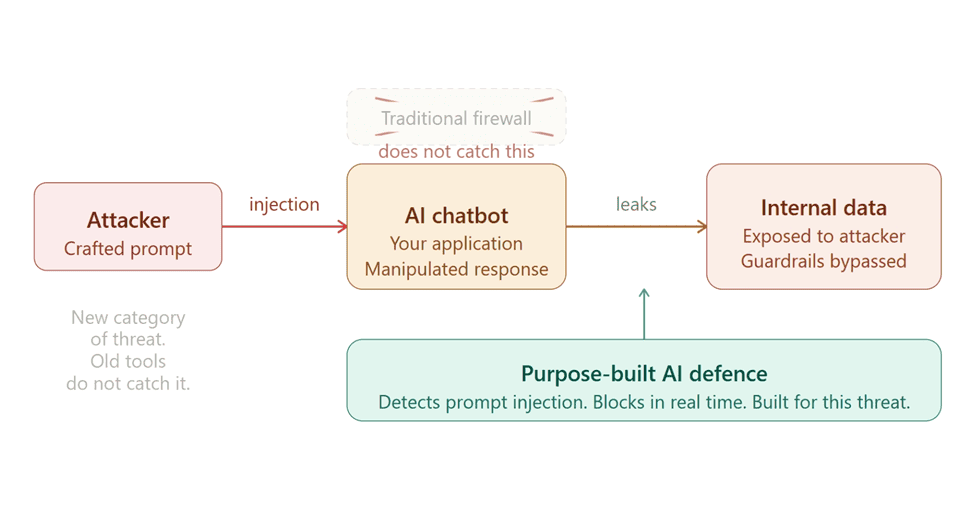
If your company is building or deploying AI-powered applications, you have a different problem on your hands. These systems are targets.
Prompt injection attacks exploit LLM instruction-following behavior to override system directives, bypass security controls, and access unauthorized data. Traditional perimeter defenses fail here because the attack operates at the semantic layer, not the network layer. Your firewall does not understand language.
A documented example: researchers manipulated an enterprise RAG system by embedding malicious instructions in a publicly accessible document. The AI leaked proprietary business intelligence to external endpoints, disabled its own safety filters, and executed API calls beyond the user’s authorization scope. It succeeded because the system treated all retrieved content as equally trustworthy.
This is not niche research finding. The OWASP Top 10 for LLM Applications ranks prompt injection as the number one threat. NIST AI RMF and ISO 42001 now mandate specific controls for prompt injection prevention and detection. If your organization has deployed AI applications and has not addressed this layer, it is worth prioritizing.
Most security conversations focus on AI assistants. The harder problem is already here.
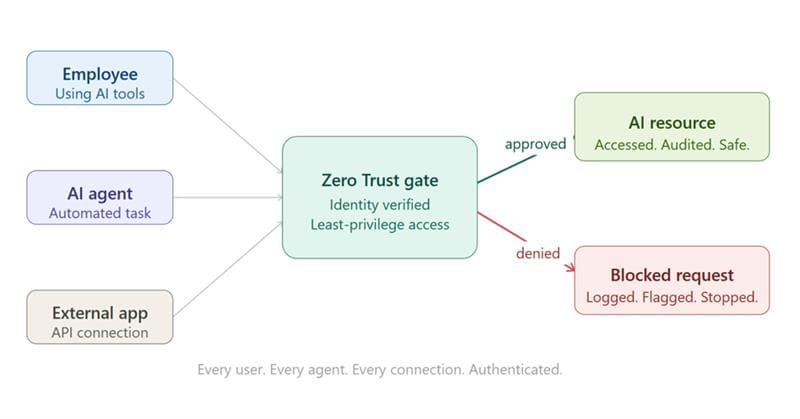
48 percent of cybersecurity professionals now identify agentic AI and autonomous systems as the single most dangerous attack vector. An AI agent is not just a chatbot. It connects to tools, reads files, sends emails, makes API calls, and interacts with other agents. Most agents today inherit broad permissions from the systems they connect to, with no zero trust boundaries governing what they can reach.
The three questions every CISO should be able to answer for every AI agent in their environment: What can this agent do? On whose behalf? And who approved it? If you cannot answer those, your agentic AI is running outside your security perimeter.
Banning AI tools is not the answer. That conversation is over. The productive question is how do you govern AI use properly.
Visibility first. Shadow AI discovery tells you which tools your organisation is using, not just the ones you approved. Security teams are now treating shadow AI the same way they treat any unmanaged identity. It needs to be found, classified, and governed continuously, not audited once a year.
Data protection at the prompt level. AI-powered data loss prevention can analyse what employees type into AI tools and block anything sensitive before it leaves. The goal is to make secure usage the path of least resistance.
Purpose-built defences for your AI applications. Prompt injection, model manipulation, and abuse at scale need tools built specifically for these threats. This is one of the areas where we see the biggest gap in most organisations. The market has evolved quickly, with dedicated solutions now covering public-facing AI applications and internal workforce usage. Getting this layer right makes a significant difference.
Zero trust for AI access. Every user, every AI agent, every connection should be authenticated with least-privilege access. Enforce zero trust for inference endpoints and tool connectors. Use Just-in-Time permissions where access is granted only for the duration of a specific task, rather than broad system access. Maintain environment separation between development, staging, and production.
Governance and compliance alignment. AI security is not just a technical problem. Enterprises are moving toward formal AI governance frameworks aligned to NIST AI RMF. If your organisation is subject to GDPR or NIS2, your AI governance posture is already part of that compliance conversation whether you have addressed it or not.
If someone asked you right now: which AI tools are your employees using, and what data are they sharing through them? Could you answer that confidently?
Only 34 percent of enterprises report having AI-specific security controls in place, and fewer than 40 percent conduct regular security testing on AI models or agent workflows. That gap is closing, but slowly. The organisations that move deliberately now will be in a stronger position as agentic AI embeds itself deeper into enterprise operations.
AI is not going anywhere. The security responsibility that comes with it is not either.
KIDAN works with organisations across Switzerland to help address these challenges. As partners of ManageEngine and Cloudflare, we bring the right tools to the table. Whether you are just starting to think about AI security or already dealing with gaps, we are happy to help. Get in touch with KIDAN.
If these are the conversations you want to have in person, KIDANVerse is where they happen. We are bringing together IT leaders across Switzerland for two practical days, Zurich on 19 May and Lausanne on 26 May, to work through exactly these challenges together. The kind of day where you leave with answers, not just more questions.


Your application is now under review. Our team will carefully evaluate your use case, commitment level, and strategic fit. If shortlisted, you will hear from us within 5 business days to schedule your Discovery Call.
Almost there – a few quick details first.